The Air Traffic Management Division (ATMD) is responsible for the provision of air navigation services to civil aircraft operating within the Hong Kong Flight Information Region (HKFIR). These services include air traffic services, and search and rescue (SAR) co-ordination. With a mission of providing safe, reliable and sustainable air navigation services, and maintaining efficient and orderly air traffic operations within the HKFIR, the ATMD is also responsible for training air traffic control (ATC) personnel, providing aeronautical telecommunication services and designing ATC procedures.
As the demand for flights to and from Hong Kong continued to rise, the ATMD will continue to closely monitor traffic growth and provide safe and efficient ATC services in a dedicated and professional manner.
Air Traffic Operations
During this financial year, there were a total of 400 336 aircraft movements at the Hong Kong International Airport (HKIA) handled by the ATMD. In addition, the division handled 358 068 overflights transiting the HKFIR (57 727 of which were flights into and out of Macau International Airport). The number of aircraft movements and overflights increased by 7.13% and 3.48% respectively year on year.
400 336
aircraft movements at HKIA
7.13% increase year on year
358 068
overflights transiting the HKFIR
3.48% increase year on year
Runway Capacity
With the commissioning of the Three-runway System (3RS) at the HKIA, the ATMD will progressively increase the runway capacity to meet the air traffic demand of Hong Kong as an international aviation hub.
Validation and Revalidation Examinations of ATC Officer Ratings
Flight safety remains of paramount importance in air traffic control operations. To ensure that CAD maintains the stringent safety standard, the ATMD's Training and Safety Section administered validation examinations for the issuance of initial ATC qualification to Student Air Traffic Control Officers (SATCOs) through a well-established mechanism. The ATMD's Operations Section also conducted regular revalidation examinations to verify the proficiency and competency standards of rated Air Traffic Control Officers (ATCOs).
279
validation and revalidation examinations
During the year, a total of 279 validation and revalidation examinations were conducted across the four ATC streams, i.e. Aerodrome Control, Approach Control, Terminal Control and Area Control. Additionally, the ATMD conducted examinations for other ATC-related qualifications and issued certificates to those who attained these qualifications, such as On-the-job Training Instructor Certificates and Clearance Delivery Certificates.
Recruitment and Training of ATC Staff
Recruitment of Air Traffic Control Officers (ATCOs) and Air Traffic Flight Services Officers (ATFSOs)
To identify candidates with strong potential in ATC and ensure they receive effective and structured training, the ATMD's Training and Safety Section has put in place comprehensive recruitment procedures and a well-structured training programme for ATC staff.
During the 2025-26 financial year, a total of 16 SATCOs and 9 ATFSOs III were recruited and joined CAD in batches. In June 2025, a new round of SATCO recruitment exercise was launched, targeting to recruit around 20 SATCOs.
In addition, the ATMD periodically reviewed relevant tests used in recruitment exercises for various posts to enhance the efficiency and effectiveness of recruitment operations. Since 2023, a new computerised recruitment tool has been introduced to further streamline and expedite the SATCO recruitment process.
As at March 31, 2026, there were 348 ATCO grade and 144 ATFSO grade established posts in CAD.
Training of SATCOs
To equip SATCOs with the requisite aviation knowledge and competencies, a structured and progressive training programme is arranged when they join the ATMD. SATCOs are required to complete a training programme comprising a number of modules at different stages. This will enable them to perform operational duties independently upon completion of the programme.
SATCOs are required to undergo induction training to acquire basic aviation and ATC knowledge first. They will then attend courses on basic ATC and flying knowledge as part of their professional training.
The basic ATC course aims to impart fundamental ATC knowledge and skills to SATCOs through both theoretical and practical training, in order to meet the training requirements set by the International Civil Aviation Organization (ICAO). Over the years, the Hong Kong International Aviation Academy of the Airport Authority Hong Kong (AAHK) has been providing local Basic ATC Courses for SATCOs. In the 2025-26 financial year, a total of 18 SATCOs completed this local course. Courses on basic flying knowledge will also be arranged to broaden SATCOs' exposure to various aspects of ATC operations from the perspective of airspace users and enhance their understanding of the basic principles of aircraft operations. In the 2025-26 financial year, a total of 22 SATCOs completed the basic flying knowledge training, which included ground lectures and simulator flying, provided by a local organisation.
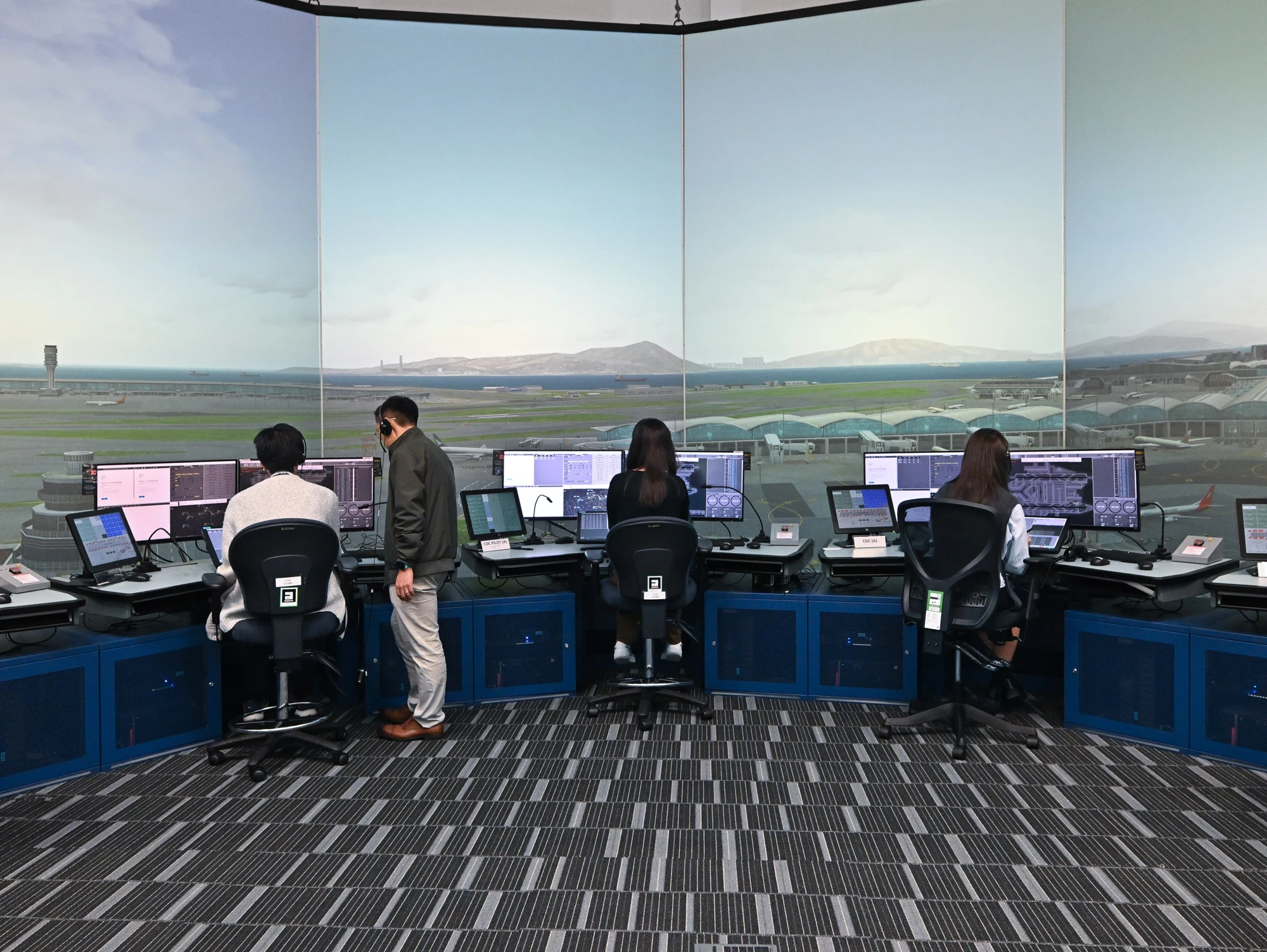
To attain the ATC professional qualifications, SATCOs will then attend specialised ATC rating courses. In addition to classroom learning, the training includes practical simulator exercises conducted in the ATC Surveillance Simulator or the Control Tower Simulator. Subject to satisfactory performance in the simulator practice, SATCOs then proceed to on-the-job training at operational working positions. During the training, SATCOs must meet the required standards to perform the ATC duties independently before they can be recommended for initial qualification checks.
SATCOs were trained in the Control Tower Simulator.
Upon passing the initial qualification check, a SATCO will be promoted to ATCO III. To become a fully-qualified air traffic control officer (i.e. an ATCO II), further specialised ATC rating training is essential. It normally takes around five to seven years for a SATCO to attain full qualification as an ATCO II.
Continuous Training for ATC staff
To ensure a continuous supply of qualified ATC manpower, the ATMD has developed a well-structured training programme for ATC personnel. This programme is reviewed regularly to ensure that operational requirements are fulfilled and anticipated air traffic growth can be adequately supported.
44
professional ATC training courses
126
ATC ratings or professional ATC qualifications
During the financial year, the ATMD conducted 44 professional ATC training courses and issued 126 ATC ratings or professional ATC qualifications.
In addition, advanced trainings in areas such as search and rescue, safety management, air traffic flow management and airspace design, were also arranged for the ATC staff to equip them with the knowledge necessary for specialised duties.
Given the importance of air traffic controllers' abilities to handle high volume of traffic and emergency situations, the ATMD arranged regular refresher simulator training during the year to ensure that controllers and trainees under on-the-job training maintained the competencies required to handle a range of operational scenarios.
New ATC and Flight Procedures
ATC Operational Procedures for the Three-runway System
Following the commissioning of the Three Runway System (3RS) at the Hong Kong International Airport (HKIA), the ATMD conducted a post-implementation review of the ATC operational and instrument flight procedures in June 2025. The review results were satisfactory and confirmed that the required safety measures were in place and effective.
To further enhance the runway operating efficiency of the 3RS, the ATMD is conducting study to introduce new Performance-based Navigation (PBN) instrument approach procedures utilising specific required navigation performance (RNP) capability. This study will lay a solid foundation for the safety assessment and subsequent implementation of the new approach procedures.
Design and Validation of Instrument Flight Procedures for 3RS
In line with ICAO Assembly Resolution A41-8 for GNSS interference, the ATMD has evaluated the use of ground-based navigation aids network, comprising Distance Measuring Equipment (DME) in Hong Kong and Macao. This network provides navigation support to PBN instrument flight procedures in terminal airspace. The DME network will provide alternative positioning sources for PBN operations, enabling transition from GNSS-based to DME network-based PBN operations along the original flight paths. The objectives were to enable continuous PBN operations with the same navigation accuracy, minimise the operational impact and reduce the workload of air traffic controllers and flight crew during GNSS interference.
Flight inspections had been completed by the Flight Inspection Centre (FIC) of the CAAC to verify the signal-in-space performance of selected DMEs along the flight procedure paths. To mitigate the risk of concurrent DME service interruptions, a co-ordination mechanism had been agreed between CAD and the Civil Aviation Authority of Macao Special Administrative Region to co-ordinate the maintenance schedule and provide ad hoc service interruption notifications. A safety risk assessment workshop had also been convened, with representatives from local airline operators, air traffic controllers, flight operations inspectors and engineers in attendance.
Implementation of the DME network-based navigation service is targeted for July 2026.
Air Traffic Services
Co-ordination with Local Airspace Users
To promote flight safety, the Hong Kong Sector Flight Safety Committee comprising local airspace users continued to meet regularly to co-ordinate flight safety issues in the local low-level airspace. These local airspace users include fixed wing operators and rotary wing operators (the Government Flying Service, the People's Liberation Army Hong Kong Garrison (the Hong Kong Garrison), Sky Shuttle Helicopters Limited, Heliservices (Hong Kong) Limited and the Aviation Club of Hong Kong, China), Hong Kong Paragliding Association and private aircraft owners.
Aeronautical Search and Rescue (SAR) Co-ordination
The ATMD continued to provide regular training opportunities for SAR-qualified ATCOs through tabletop SAR exercises to maintain their expertise in this area.
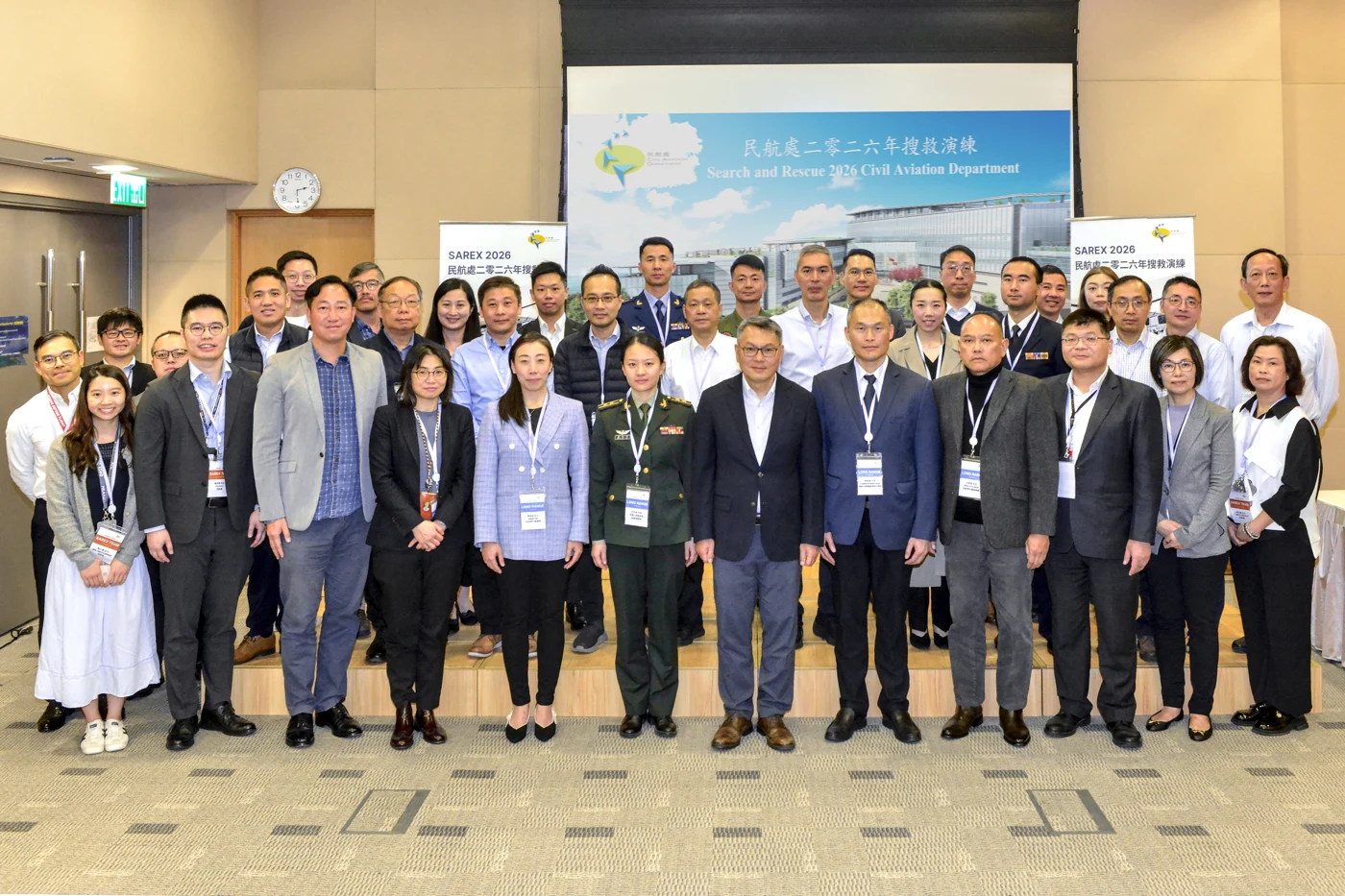
Additionally, in accordance with the recommendation outlined in Annex 12 to the Convention on Civil Aviation by ICAO, CAD conducted a 2-day SAR exercise encompassing both a short-range exercise held at Mong Tung Wan on Lantau Island and a long-range exercise in the proximity of 50 nautical miles south of Hong Kong. The exercise serves to foster co-operation and co-ordination among SAR units, and promote technical exchange to enhance efficiency in SAR operations. These initiatives demonstrated CAD's commitment to aviation safety.
Participants and observers of the long-range exercise alongside with the then Director-General of Civil Aviation, Mr Victor Liu (front row, sixth from right).
Aeronautical Information Management
The Aeronautical Information Management Centre (AIMC) is responsible for the provision of aeronautical information to the aviation community in the form of aeronautical information products necessary for the safety, regularity and efficiency of air navigation. Aeronautical information products provided by the AIMC include the Hong Kong Aeronautical Information Publication (AIP), AIP Amendment, AIP Supplement, Aeronautical Information Circular, Notice to Airmen (NOTAM) and aeronautical charts. The AIMC is also responsible for processing flight plans for flights departing from the HKIA. All aeronautical information products are available on the Hong Kong Aeronautical Information Services website (www.ais.gov.hk).
To support the digitalisation of aeronautical information management, the AIMC will commence the enhancement of the AIM System in 2026 with a tentative target for completion by the end of 2028.
In the year, the AIMC handled 1 249 261 NOTAMs and 221 037 flight plans.
Aeronautical Telecommunication Services
The Aeronautical Network Centre (ANC) offers reliable, high quality and efficient aeronautical telecommunication services for the exchange of air traffic service (ATS) and operational meteorological messages in support of air navigation services. The ANC provides a 24-hour aeronautical broadcasting service by means of voice and digital dispatch to aircraft in flight for acquiring latest weather information necessary for flight operation. In addition, to ensure network security of the ATC systems, the ANC monitors firewall systems in real time and provides a 24-hour network security alerting service.
106 631 413
messages handled by the ANC
9% increase over the previous year
379 352
operational meteorological messages
6% increase from last year
With the continuous growth in air traffic, the number of ATS message exchanges continued to rise. The ANC handled 106 631 413 messages, representing a 9% increase over the previous year. For aeronautical broadcasting services, the system dispatched 379 352 operational meteorological messages to aircraft in flight, a 6% increase from last year.
To align with the ICAO strategy for Common Aeronautical Virtual Private Network (CRV) implementation in the Asia-Pacific region, the ANC will expand its Internet Protocol-based infrastructure by transitioning the legacy Ho Chi Minh City Aeronautical Fixed Telecommunication Network (AFTN) circuit to CRV in early 2027. In parallel, a new project will be launched to enhance the ATS Message Handling System (AMHS) to support System-Wide Information Management (SWIM) across the network, with completion targeted for 2028.
Air Traffic Flow Management for Asia-Pacific Region
CAD has been actively participating in harmonising the Air Traffic Flow Management (ATFM) with other Air Navigation Service Providers (ANSPs) in the Asia-Pacific region. Working hand in hand, CAD and the relevant authorities in Singapore, Thailand and the Chinese Mainland jointly developed the Distributed Multi-nodal ATFM network, a concept of Common Operational Procedure (COP) for the ATFM applicable to the Asia-Pacific region. The ICAO also adopted this concept in establishing a framework of cross border ATFM in the Asia-Pacific region with the participation of many Asia-Pacific countries, such as the Philippines, Vietnam, Malaysia, Indonesia, Cambodia and Korea.
The primary ATFM measure in the COP is the use of the Ground Delay Programme (GDP). It regulates the air traffic flow by allocating Calculated Take-Off Time to offset airborne delays, so as to solve the imbalance between demand and capacity of the airport and airspace caused by weather or other unexpected events. Flights could be managed in a more organised manner, thus reducing fuel consumption and environmental pollution.
A new regional collaborative decision-making mechanism, namely Traffic Flow Coordination Call (TFCC), spearheaded by the Air Traffic Management Bureau of the Civil Aviation Administration of China, the Civil Aviation Department and the Civil Aviation Authority of Singapore, was established in 2025. Under this mechanism, key ANSPs in the Asia-Pacific region share operational ATFM information daily, including current-day strategies, implementation of pre-tactical to tactical ATFM measure , so as to improve situational awareness among ANSPs in the region, enhance operational safety and minimise traffic delays.
CAD continues to act as a bridge between Northeast and Southeast Asia so as to promote the air traffic flow management in the Asia-Pacific region and enhance the air navigation services for the entire region.
Air Traffic Management in the Guangdong-Hong Kong-Macao Greater Bay Area
CAD has spared no effort in consolidating and enhancing Hong Kong's status as an international aviation hub as well as promoting the development of a world-class airport cluster in the Guangdong-Hong Kong-Macao Greater Bay Area (GBA), including the 3RS of the HKIA and the expansion of other airports in the GBA. CAD has been collaborating closely with the Air Traffic Management Bureau of the CAAC and the Civil Aviation Authority of the Macao Special Administrative Region through the Tripartite Working Group (TWG) on air traffic management (ATM) matters in the GBA. This collaboration aims to jointly formulate appropriate measures to optimise the operational efficiency of all airports in the region. Over the years, a number of ATM enhancement measures have been implemented, enhancing air traffic flow and efficiency in the GBA as well as facilitating air traffic in the region to develop sustainably in a safe and orderly manner.
In the year, the TWG held eight meetings at various hierarchical levels to continuously enhance ATM initiatives. In September 2025, the TWG held a civil aviation high-level ATM meeting in Macao, making key progress in various aspects, including the fast-time simulation modelling. It was conducive to the implementation of the related airspace optimisation measures, enhancing the operational efficiency of ATM in the GBA airspace. The TWG agreed to pursue new regional routes connecting the GBA and the Southeast Asia in the international fora. To support orderly implementation of national policies on low-altitude economy, the three parties will continue to maintain close communication and collaboration.
With the full support of the ATMB of the CAAC, CAD will continue to put forward various enhancement measures in phases, proactively aligning with the National 15th Five-YearPlan to further strengthen and enhance Hong Kong's status as an international aviation superhub.
Safety Management System
To minimise safety risks during daily operations, the ATMD has implemented a comprehensive Safety Management System, dedicated to prioritising safety, strengthening the Division’s safety culture, and continuously improving safety performance in the Hong Kong airspace. Through a risk management approach, various measures such as safety data collection and analysis, are conducted to proactively identify potential safety issues. Appropriate risk mitigation measures and corrective actions are then implemented in a timely manner to prevent safety incidents.
The ATMD continuously monitors safety performance and compiles quarterly summaries for review by the Air Traffic Management Standards Office, an independent regulatory office for ATM-related matters. In addition, an internal audit programme is in place for key functional areas of the ATMD to ensure that all operations remain in compliance with the established standards and safety management requirements.
Overseas Aeronautical Meetings and Conferences
Being one of the prominent ANSPs in the Asia-Pacific region, the ATMD is dedicated to maintaining continuous and close collaboration with other ANSPs in the region through active participation in a variety of conferences and workshops convened by the ICAO, the Civil Air Navigation Services Organisation (CANSO) and other civil aviation authorities.
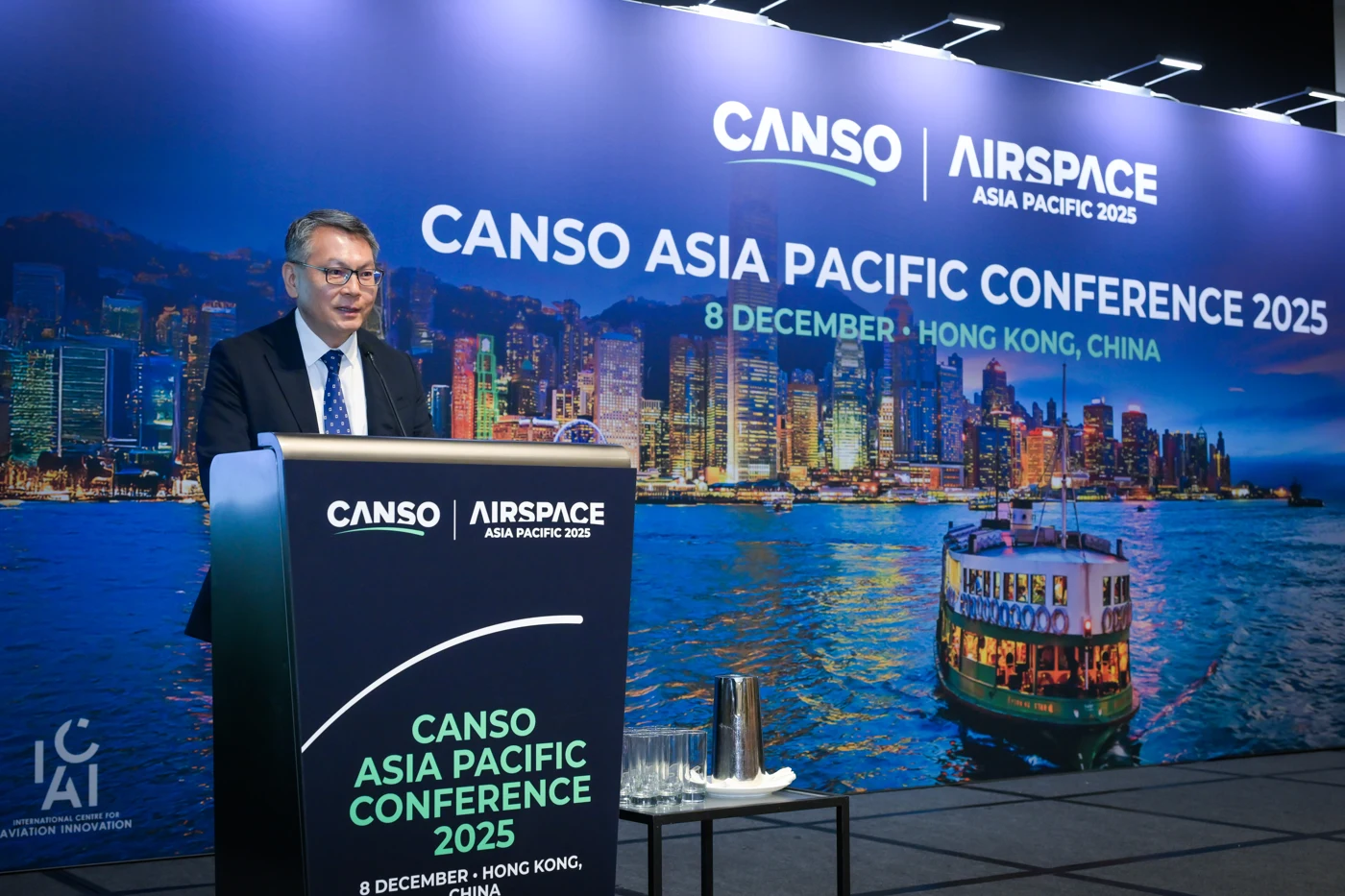
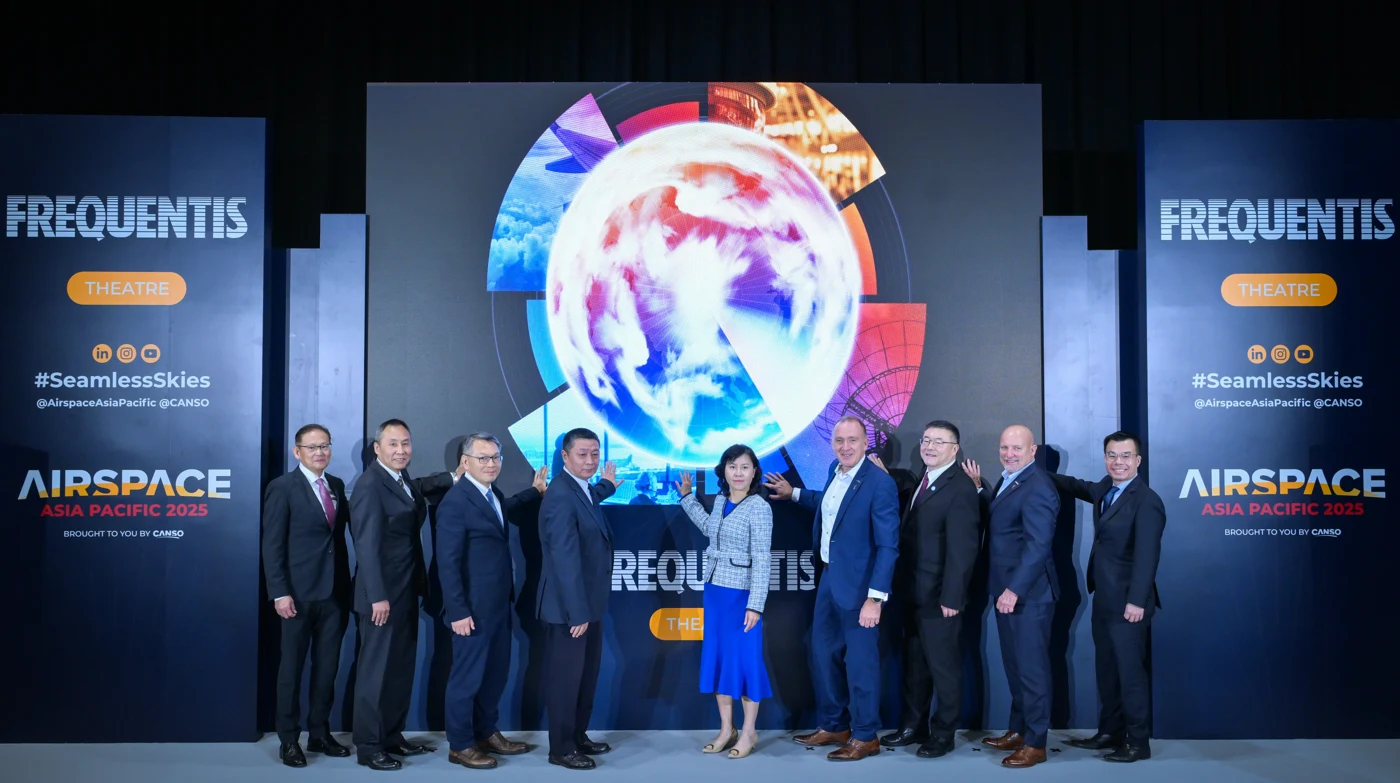
In December 2025, CAD, in collaboration with CANSO, successfully hosted two back-to-back large-scale international conference and exhibition events, namely CANSO Asia Pacific Conference 2025 and Airspace Asia Pacific 2025 exhibition.
Being the first-ever Asia-Pacific branch under CANSO’s Airspace World, the Airspace Asia Pacific 2025, themed “Shaping the Future of Asia Pacific’s Skies”, had brought together more than 2 000 attendees including decision-makers from ANSPs, professionals, and representatives of regulatory bodies and innovative technology companies from around the world, collectively driving global air traffic into a new era of digitisation and intelligence.
At CANSO Asia Pacific Conference 2025 held under the theme of “Seamless APAC Airspace – Aviation and Meteorology Integration”, professionals from ANSPs, regulatory bodies, airports, meteorological studies, and research institutes gathered together to address the growing impact and challenges of unpredictable weather on air traffic management. Topics of sharing sessions and panel discussions included managing weather challenges in aviation, the science and challenges of weather, operational synergy through integration and building resilience in the aviation-meteorology ecosystem. The conference culminated with the signing of Letter of Intent by 10 ANSPs and meteorological services providers on strengthening aviation meteorology collaboration, signifying the co-operation and integration between aviation and meteorology professionals.
The then Director General of Civil Aviation, Mr Victor Liu, delivered an opening speech at the CANSO Asia Pacific Conference 2025.
The CANSO Airspace Asia Pacific 2025 exhibitionfeatured multiple keynote sessions and panel discussions focusing on exploring the most significant challenges and opportunities in air traffic management. Topics covered low-altitude economy, green aviation, artificial intelligence, climate challenges, etc. The event also attracted over 70 exhibitors presenting cutting-edge technologies in air traffic management, low-altitude traffic management, artificial intelligence applications and aviation, driving the industry towards a sustainable future with digitalisation and automation, thus creating a safe, seamless and green airspace.
Officiating guests took the stage to kick off Airspace Asia Pacific 2025.
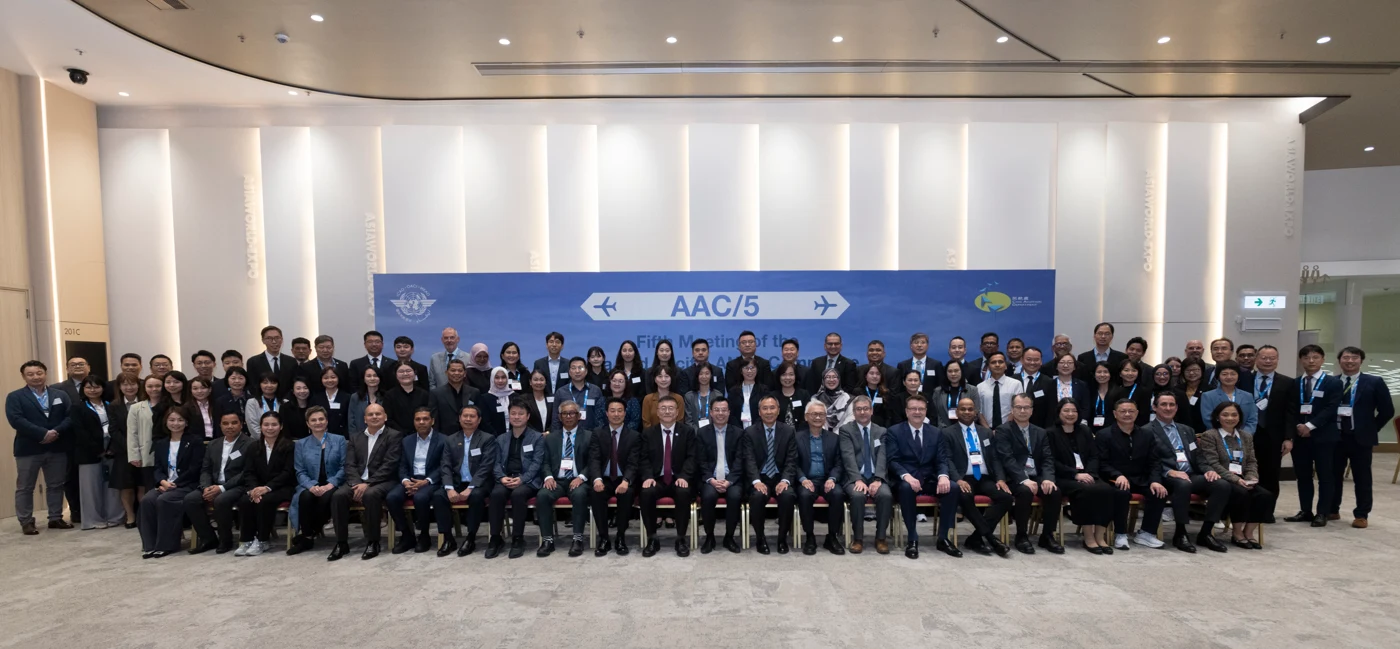
Taking chance of the convergence of aviation leaders from Asia Pacific region, the ICAO Fifth Meeting of Asia Pacific ANSP Committee (AAC/5) and CANSO Operations and Safety Working Group Meetings were held right after the two major events.
The Fifth Meeting of Asia Pacific ANSP was held smoothly.
Hosting these important international meetings in Hong Kong demonstrates the city’s role as an international aviation hub. CAD actively participated in and supported these international aviation meetings hosted by CANSO, and will continue to collaborate with international aviation partners and stakeholders to enhance the development of air traffic management and low-altitude traffic management.